Friday, May 11, 2012

A Moveable Feast

English thesis cohort 2012

Monday, April 23, 2012

Acknowledgments


I would like to thank Professor Josephine Hendin for taking this project under her wing from its inception: a $500 summer grant, which paid for gas from Atlanta to Berkeley.  I owe her everything.
I am also very grateful to Ph.D. Candidate Brendan Beirne for advising; to Professor Maureen McLane for coaching; to Professor Bryan Waterman for supporting; and to Professor David Hoover for inspiring.
            Greatest of all are my debts to Ki B. Kim, Jean Hee Kim, and my red pony, N. Bird.

e. k.

New York
May, 2012

Friday, April 20, 2012

Abstract

A Teleological and “Non-teleological” Continuum: Rethinking Causality and Narratology in Steinbeck’s Short Novels

Celebrated in large part for The Grapes of Wrath, John Steinbeck at first glance seems to lean toward the teleological, which deals with the final cause or purpose for which an event occurs.  The mobilization of the Joad family from Oklahoma to California, an endpoint, and the final cause behind that movement (e.g., the Dust Bowl, the economic climate, the vilified agricultural conglomerates) hint at a telos-driven understanding of life, that everything happens for a reason.  But within a cultural and historical context of capitalism, work and reward, and an epidemic as severe as the Great Depression, previous notions of purpose and causality that grounded Americans in the 20s and 30s were harshly stripped away.  As if in response to such disillusionment, Steinbeck later sought other disciplinary avenues that explored contemporary perspectives on life, philosophy, and biology—in a more holistic fashion.
In 1940, Steinbeck and marine biologist Edward Ricketts journeyed to the Gulf of California to collect intertidal specimens for Sea of Cortez, an ecological catalogue and travel narrative.  The book’s Log, published separately in 1951, includes a controversial chapter on “non-teleological” thinking, Ricketts’s neologism for what is essentially noncausal thinking.  Questioning teleological thinking, non-teleological thinking contrastingly accepts life as it is and gears instead toward a holistic view of events.  Earlier episodic and cyclical works like Tortilla Flat and The Red Pony propagate this conception of random experience.  Such novels complicate Steinbeck’s fiction and showcase its duplicity as a tradition that is not completely in line with the biological determinism of naturalists like Norris and Dreiser, or even with the fragmented cynicism and modernism of contemporaries like Hemingway and Faulkner—but rather of its own brand, a Steinbeckian experience in which both worldviews, one with an ultimate aim and another completely random, coincide and even battle.  Aesthetically, too, Steinbeck’s work is certainly distinctive in literary history: straightforward prose and direct representation within a context of high, allusive modernism.
Considering Steinbeck at this crossroads of naturalism and modernism, my essay analyzes the teleological and the non-teleological in his earlier short novels, through the literary veins of thematic and narrative structure.  In Chapter One, I argue that The Red Pony cycle uses both modes of thinking to represent the modern inability to reconcile one’s attitudes toward human (and animal) mortality.  Is death something that can be explained, understood, and then changed, or is it something that just “is”?  In Chapter Two, I read the Tortilla Flat sequence narratologically, arguing that the paisano stories, as written transcriptions of oratures, reflect the dualities that are endemic in Steinbeck’s storytelling: memory and narrative, orality and literacy, and non-teleological and teleological.  Concluding that Steinbeck carefully balances both to honestly represent the duality of experience, my essay, ultimately, reevaluates his status as a naturalistic novelist and highlights the more interesting dichotomies that make Steinbeck particularly Steinbeckian.

Tuesday, August 16, 2011

San Jose, CA (and a Note on Archival Research)


A journal entry before our escape:
 After six days on the road and five nights in motels, I thought I’d feel some kind of relief at Andrea’s house, our subletting host.  But two days in, Becky and I have already decided to pack our bags and leave for another city.  Aside from the fact that my research work is done here in Oakland, I can’t help but consider the reason for our sudden leave-taking at the first sign of stability: we’re really just cold, selfish individuals with dark and twisty histories of daddy/mommy, anxiety, and serious intimacy issues who can’t deal with hospitality and general kindness.  Andrea leaves long two-sided messages about weather, coffee, and the opera singer downstairs; she offers breakfast bars and coffee before we leave; she smiles much too frequently for someone who lives alone with that many cats.
Leaving a fifty on the desk with a short thank-you note, and taking one of the gross blue tortilla chip bags she had left us (solely to make her think we had eaten them), Becky and I made our way to San Jose State University for their Steinbeck Center.  My first day at the world's largest Steinbeck collection had me overwhelmed, and not in a good way.  They had everything.  (A note to future archival researchers: never enter a special collections without knowing exactly which items you need and want to look at, and bring change for copies.)  After five hours of perusing letters, journals, book reviews, and dissertations, the center closed and an entire day felt wasted because I had copied nothing.  There was just too much to look at let alone take home.

That night in the motel I went over my Berkeley notes and my grant proposal to remind myself of why I was in California, what Dean Kalb had given me a whopping half-grand for: to address issues of canonicity in American literature through the reception history of Steinbeck's short novels.  Sounds smart and important enough, right?  I was blinded, however, by the overly teleological prospects of saving the world with my study on why we as the American English Academy-with-a-Capital-A have canonized highbrow writers like James and Fitzgerald but have kept the "middlebrow" working class subjects of Steinbeck's fiction in our high school curricula.  The "why," essentially, was the problem: an end goal in mind, when instead I should have been exploring Steinbeck non-teleologically in order to allow for greater possibilities and a deeper understanding (which will or will not make sense at the end of this blog series).

After getting this all out of my system, I marched into the Center the next day with a new confidence and spent the rest of my time there making copies of books reviews from the 30s and 40s on: The Red Pony, which I would later use for my paper, Tortilla Flat, The Pearl, Of Mice and Men, and Cannery Row -- the short novels.  Despite my feeling of productivity that day, however, I still had no idea what the hell my project was.  I was secretly hoping that, by the end of it, I'd be able to look through my research and find something, some pattern or flashing bulb (in hindsight, a slightly poor way to go about things).  Brendan did tell me to let the research guide me, to not necessarily worry about sticking to the original proposal.  So at the time, that's what I did.

EK

Saturday, August 6, 2011

Santa Cruz, CA


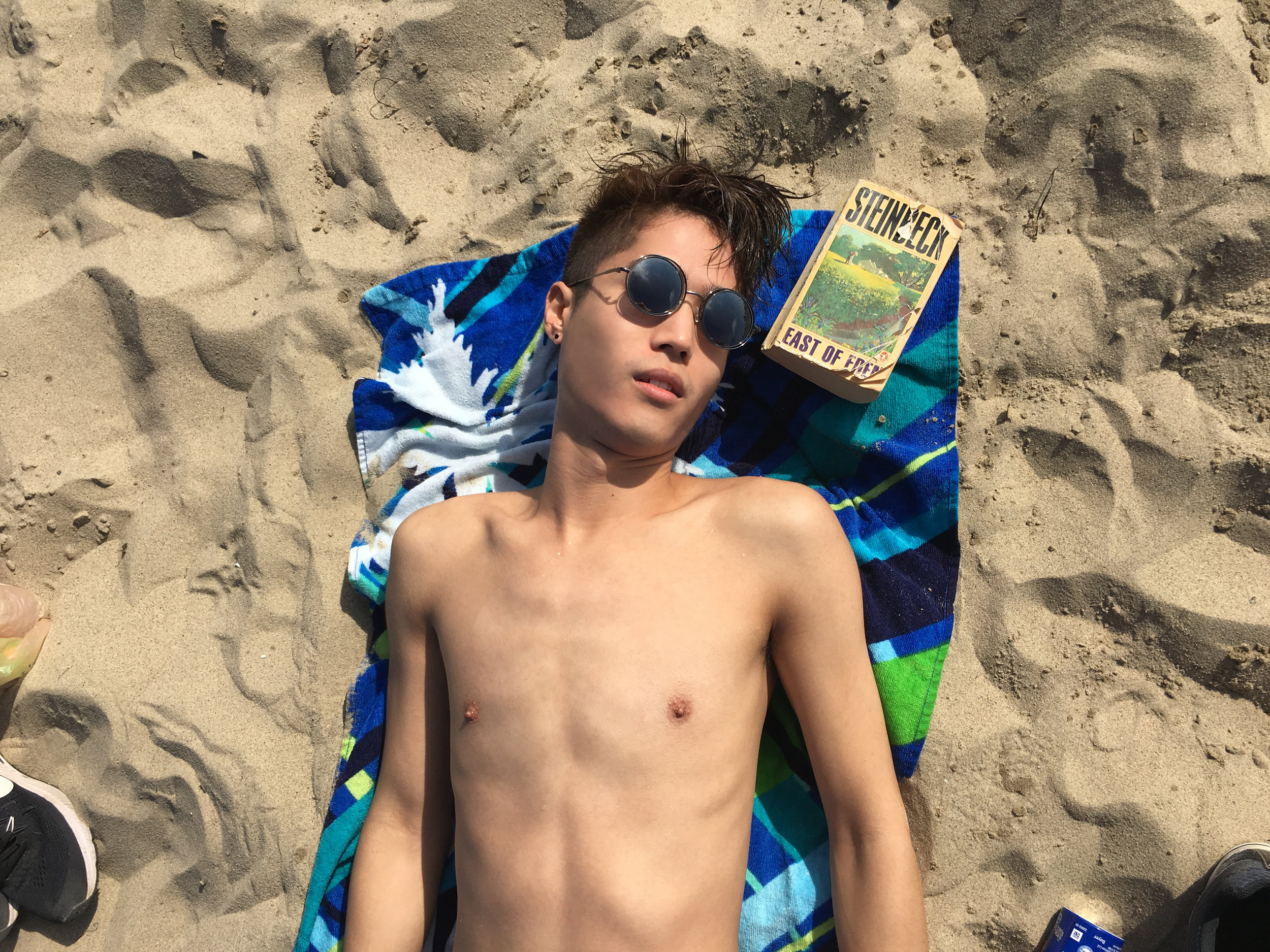
My cousin's alma mater and our "break" before another round of archival research-filled days in dark and twisty library rooms, Santa Cruz was just what we needed.  Traffic was almost unbearable and parking was severely limited, but it was totally worth it once we got to the Boardwalk on that gorgeous Sunday afternoon.  We cruised the tall line of palm trees, stumbled upon a lovely happy hour brunch of duck sliders and oysters (YUM), and bought from a stand two towering vanilla-strawberry swirl ice cream cones for dessert.  It all looked and felt like California, from the beautiful people to the golden sand.

At the time, however, the "West Coast" accent of the whole thing unsettled me just a little.  As an East Coaster through and through, I couldn't help but feel out of place and miss home: brown Georgia and black and grey New York.  Becky and I said it too often during the trip, but: "People are too happy here."  And all that skin is cruelly tantalizing for a pasty individual such as myself; I was excited to get back into the archives where people were clothed and bookish.  We laid out, nonetheless, and enjoyed what we had while we had it--the sun, the sand, the beautiful people.

Aside from finishing Tortilla Flat, I did absolutely nothing all day, not unlike Steinbeck's paisano's -- just without all that wine and house burning.

EK

Friday, August 5, 2011

Berkeley, CA - à la Eric


A letter to my advisor:
June 17, 2011
  Dear Brendan:
 Thanks for the recommendations.  Our first meal at Berkeley was actually at Top Dog.  Then we took your advice and had the crispy prawn tacos at Cancun - very delicious, and after went to Moe's, where I bought a '37 edition of Tortilla Flat for $5.
 A quick update: Currently waiting for Bancroft to open.  Wrapping up my research here today and driving to San Jose tonight, where I'll be dividing my time between Stanford and San Jose State.  Berkeley didn't have as much as I thought, but it was a good starting point to get in the groove and learn the ropes of archival research.  Now I can go into the other collections and use my time more wisely (and they have much cooler things).
 So far I've found letters and letters, which was unreal, the whole touching-Steinbeck's-actual-handwriting thing, until I realized how much time I was wasting reading these personal correspondences.  I've learned to skip anything that says "memorabilia" and "To Wives #1, 2, and 3," and instead bookmark letters to agents, reviewers, and university friends.  Important reasons why I had to specifically come to Berkeley: an unpublished nonfiction manuscript entitled "Argument of Phalanx" (a gift to the school), pages of book reviews collected by James L. Henry, and the aforementioned letters, which address his education, writing style, public reception, and ideas.
 Hope the occasional email is okay for now; Internet and phone service are sporadic when jumping from motel to motel.  After Stanford, Becky and I are driving up to Portland to see my cousin, then it's Montana, a few of its trails, Colorado, St. Louis, and back to Georgia, after which I'll fly to New York by July 3rd for a poetry course and this.  Will you be in town then to meet or talk about the independent study?
 Also: sorry for the length.  I haven't been journaling at all since we hit the road, so this email is in large part for me too.
  Thanks for everything,
  Eric

Berkeley, CA - à la Becky

Our first day on Bancroft Way

A funny note that Becky posted on our family message board, apparently, while I was sitting right next to her:
 Day five of our road trip (travelled through Arkansas, Texas, New Mexico, Arizona) and we are finally here at UC Berkeley in the Bancroft library. 
 I am feeling extremely out of my league here. Everyone around me is probably writing novels or crazy thesis papers or something fancy and prestigious and they all look like future lawyers or researchers or something else that's elite. And I'm wearing a t-shirt, cut off shorts, and a hat to cover my horrible "I just spent the last 5 days in a car" hair looking like I'm about to head to the beach. I can't stop looking around and laughing with how out of place I look and I'm sure me smiling like an idiot while everyone else looks so serious isn't making me blend in more. 
 So now I'm furiously typing this Crib entry so I look like I'm doing something really important and prestigious too as I wait for Eric to finish with his research for the day. I seriously feel like a little kid who followed their dad to work and is now told to sit in the corner and color and to not bother any of the adults because they're doing "grown up" work. 
 California is sunny, clear blue skies, perfect 75 degrees with a light breeze as it always is here. It feels..... like California. 
 Tonight, we finally get to settle into our sublet house. Hurray for finally being able to nest without the "this is going to be a bitch to pack up tomorrow morning" feeling.
 Since I have another hour to kill, trying my best to just color in my corner and not embarrass Eric, I shall post some road trip pics.